Monday, June 18, 2012
Arise, O GOD, And Judge The Earth - Boston Byzantine Choir
+++
Arise, O God, judge the earth; for you shall inherit all the nations! (Psalm 82:8)
The Boston Byzantine Choir:
http://www.stmaryorthodoxchurch.org/multimedia/bbc.php

Sunday, June 17, 2012
Wisdom From Elder Ephraim of Philotheou, Mt. Athos & Arizona

Compel yourselves in the JESUS Prayer: this will become everything to you -- food and drink and clothing and light and consolation and spiritual life. This prayer becomes everything for him who possesses it. Without it, the emptiness of the soul cannot be satisfied. Do you want to love CHRIST? Long for the Prayer and embrace humility, and then you will realize that the Kingdom of GOD is within us.
+++
The Christian struggle is glorious, for the prize is not something ephemeral, but it is eternal glory up in heaven! Blessed is he who is wise in GOD, for no account will be demanded of him, and he will not find himself in a difficult position when GOD calls him to give an account for his time on earth.
+++
May the grace of CHRIST be with you, within your soul, my child, to enlighten and increase your love for HIM, so that you may be kept near HIM and not be swept away by the current of worldliness and fall away from GOD and lose your immortal soul, which is more than the entire world. The amount of grace that came to you is small; the saints, though, had much grace. In order to increase it, you must humble yourself. If you become proud it will leave, and then you will weep. So be very careful to bear in mind your sins and passions, so that vainglory will not sprout in you and drive away the JESUS Prayer.
+++

"Let not your heart be troubled, nor let it be afraid (Gospel of St. John 14:27)." My children, trust that GOD will not let us be tempted beyond our strength; along with the temptation will come the help of GOD. Our CHRIST tells us that if they hated ME they will also hate you (Gospel of St. John 15:18). If they persecuted and blasphemed and cursed ME, they will also persecute and blaspheme and curse you. And they will do these things to you because they do not know GOD and "they know not what they do (St. Luke 23:43)." We, my children, know GOD, and because we love HIM and are HIS, the world hates us, since it does not agree with HIM. Therefore have courage, my children; we are followers of the ONE WHO was crucified by them; so too we will be crucified by trials and temptations. Just as HE was resurrected, we too will be resurrected and glorified together with HIM unto the ages of ages.
+++
Do not grieve your Elder or your brother monk, for immediately your peace of soul stops, the JESUS Prayer ceases, and you are full of thoughts. The cure is: Confession, burning tears, and sincerely grieving others. Be careful, if you have something against your Elder, be careful, for the devil will crush you and mislead you easily.
+++
Man is easily corrupted; he falls easily; he is changeable, mutable, prone to fall. GOD knows this because HE formed us. HE made us human. But HE also gave us the grace to repent; HE has given us the power to arise. Why didn't you do this? When HE reproves you through your conscience and exhorts you through the Scriptures to repent, and you do not do so, then the condemnation and punishment begin.
+++
The remembrance of GOD is an all-powerful weapon, a mighty suit of armor against satan and the various sins. When the mind ceases to remember GOD and meditate upon divine things, man is overcome by negligence, indolence, forgetfulness, and then by evil desires! If you see your mind rushing towards the world, know that your soul lacks divine consolation, which is why it turns to the world for consolation. When a person's soul is warm towards GOD, he is enlightened and feels compunction, and it is impossible for his mind to incline towards the world at the same time. The soul inclines towards the world when it is united, in a sense, with GOD.
+++

Do not be disheartened; do not lose courage. Sometimes the holy nurse -- the grace of GOD -- leaves us, and we fall into ridiculous and indecent thoughts, and sometimes even words, so that we might be humbled and not think highly of ourselves, but rather become aware of our weakness, that we are unable to do any good without the grace of GOD.
+++
We owe thousands of thanks to the sweetest HEAVENLY FATHER, WHO providentially allows painful events to occur in our lives, so that we will not find ourselves in the other world incapable of showing that we endured something for the sake of HIS Love.
--Elder Ephraim of Philotheou
Saturday, June 16, 2012
St. Peter the Aleut Martyr

Saint Peter the Aleut is mentioned in the Life of St Herman of Alaska (December 13). Simeon Yanovsky (who ended his life as the schemamonk Sergius in the St Tikhon of Kaluga Monastery), has left the following account:
"On another occasion I was relating to him how the Spanish in California had imprisoned fourteen Aleuts, and how the Jesuits (actually Franciscans) were forcing all of them to accept the Catholic Faith. But the Aleuts would not agree under any circumstances, saying, 'We are Christians.' The Jesuits argued, 'That's not true, you are heretics and schismatics. If you do not agree to accept our faith then we will torture all of you to death.' Then the Aleuts were placed in prisons two to a cell. That evening, the Jesuits came to the prison with lanterns and lighted candles. Again they tried to persuade two Aleuts in the cell to accept the Catholic Faith. 'We are Christians,' the Aleuts replied, 'and we will not change our Faith.' Then the Jesuits began to torture them, at first the one while his companion was a witness. They cut off one of the joints of his feet, and then the other joint. Then they cut the first joint on the fingers of his hands, and then the other joint. Then they cut off his feet, and his hands. The blood flowed, but the martyr endured all and firmly repeated one thing: "I am a Christian.' He died in such suffering, due to a loss of blood. The Jesuit also promised to torture his comrade to death the next day.
But that night an order was received from Monterey stating that the imprisoned Aleuts were to be released immediately, and sent there under escort. Therefore, in the morning all were sent to Monterey with the exception of the dead Aleut. This was related to me by a witness, the same Aleut who had escaped torture, and who was the friend of the martyred Aleut. I reported this incident to the authorities in St Petersburg. When I finished my story, Father Herman asked, 'What was the name of the martyred Aleut?' I answered, 'Peter. I do not remember his family name.' The Elder stood reverently before an icon, made the Sign of the Cross and said, "Holy New Martyr Peter, pray to God for usl"
We know very little about St Peter, except that he was from Kodiak, and was arrested and put to death by the Spaniards in California because he refused to convert to Catholicism. The circumstances of his martyrdom recall the torture of St James the Persian (November 27).
Both in his sufferings and in his steadfast confession of the Faith, St Peter is the equal of the martyrs of old, and also of the New Martyrs who have shone forth in more recent times. Now he rejoices with them in the heavenly Kingdom, glorifying God, the Father, the Son, and the Holy Spirit, throughout all ages.
+++
Troparion (Fourth Tone):
Today Alaska rejoices and America celebrates, For the new world has been sanctified by martyrdom. Kodiak echoes with songs of thanksgiving, Iliamna and Kenai observe the festival of faith. The Apostle and martyr Juvenaly is glorified, And Peter the Aleut is exalted by his voluntary sacrifice, In their devotion and love for the Lord, They willingly endured persecution and death for the Truth, Now in the Kingdom of Heaven they intercede for our souls!
+
Kontakion (Fourth Tone):
Today Valaam joins Alaska In celebrating this joyous feast, As her spiritual son Juvenaly Embraces the new martyr Peter with love. Together they suffered for the Lord in America And united the old world with the new by their voluntary sacrifice. Now forever they stand before the King of glory and intercede for our souls.
+
Troparion (First Tone):
O Peter, upon the rock of thy faith hath Christ built His Church, and in the streams of thy blood hath He hallowed our land. In thee thy people hath been sanctified, O Aleut; from the farthest islands of the west hath He raised thee, a light unto all. Glory to Him that hath glorified thee. Glory to Him that hath crowned thee. Glory to Him that worketh healings for all through thee.
+Holy New Martyr Peter, pray to God for us!
+++

The Historical Background of the Martyrdom of St. Peter the Aleut
by Marina D. Ilyin
The holy martyr Peter Tchounagnak was an Aleut Indian converted to Orthodoxy in the late 18th or early 19th century by Russian Orthodox missionaries. He departed this life in San Francisco, California on Sept. 8, 1815, martyred for refusing to become Roman Catholic at the hands of Padre Abella at Dolores Mission. Little or no public interest was accorded him until quite recently. How is it that he has attracted the public's attention, and why so late? When the Russian Orthodox Church began to compile information on the first missionaries sent to Alaska, and particularly when considering the canonization of St. Herman of Alaska, an account by one of Peter's fellow prisoners was found among the notes of St. Herman's devoted spiritual son, Simon Yanovsky (who was later to become Schema-monk Sergei), which relates the Aleut martyr's death.1 Yanovsky, in turn, told Father Herman in 1819, at St. Paul's Harbor on Kodiak Island, later relating their conversation in writing as follows:2
Once I told him how the Spaniards in California had taken fourteen of our Aleuts captive, and how the Jesuits had tortured one Aleut to death, trying to force them all to accept the Catholic faith, to which the Aleuts did by no means consent, answering: "We are Christians, we have been baptized," showing them the crosses on their necks.
But the Jesuits retorted: "No, you are heretics and schismatics, and if you do not agree to accept the Catholic faith, we will torture you to death." And they left them in the prison until evening, two to a cell, to think it over.
In the evening they came with lanterns and lighted candles and began again trying to persuade them to accept the Catholic faith. But the Aleuts, permeated with Divine Grace, firmly and decisively answered that they were Christians and would not change their faith. Then these fanatics began to torture them. At first one, with the other as witness. At first they cut off one joint of his toes, one toe at a time, then the next joint; he endured everything and kept on saying: "I am a Christian, and will not change my faith." Then they cut off one joint from each of his fingers, then the next joint; then they chopped off his hands, then his feet – the blood flowed. But the martyr endured to the end and repeated unchangingly this one phrase. He died from loss of blood.
The next day they wanted to torture others, but the same night an order came from Monterey that all captive Russian Aleuts be sent at once under guard to Monterey; and so on the next day all, except the deceased, were sent off. This was told to me by an Aleut who was an eyewitness, a comrade of the martyred one; he later escaped captivity by fleeing. Upon hearing this report I reported it to the Central Administration in St. Petersburg.
When I finished relating this to Fr. Herman, he asked me, "And what was the name of the martyred Aleut?" I answered, "Peter, but I don't remember his last name." Then he got up and stood before the icons, piously crossed himself and pronounced these words: "Holy New Martyr Peter, pray to God for us!"
The only other information given about Peter was Yanovsky's introduction:3

The Russian-American Company founded Fort Ross, not far from San Francisco, in 1812. There climate and soil favored agriculture, stock raising, a vegetable garden and the like; all this was to be of use to the Company. This required manual labor. Some Russians and Aleuts, coming from the northern regions to work, were settled there. But the new colony of Russians, being situated at the border of California, which then belonged to Spain, aroused suspicion in the Spaniards concerning the aims of the Russian-American Company. Fearing that the Russians meant to take possession of the town of San Francisco, the Spanish government began to demand that they abandon Fort Ross, and it began to cause various unpleasant incidents. Finally in 1815 the Spanish arrested some twenty or thirty Russian Orthodox Aleuts. Some of those arrested were held in San Francisco, while others were deported to other places. They were forced to labor and were badly treated. It is known how fourteen Russian Orthodox Aleuts ended up in prison in San Francisco and for some reason fell into the hands of the Jesuits.
Despite its brevity and sketchiness, both as proof of Father Herman's merits as a missionary and to inform Orthodox Christians about the first Orthodox martyr on American soil, this account was translated from the Russian and reprinted in Vol. III No. 3 (issue #14, June-July 1967) of The Orthodox Word. Thereafter, Peter's fame and veneration grew so rapidly that when his cultus spread beyond the boundary of private prayer into public worship, he was added to the list of candidates awaiting solemn glorification.4 As a result, and following St. Herman of Alaska's canonization in 1970, as people continued to inquire about the history of Peter's life, I was asked by my Church to see what information could still be unearthed concerning him and to answer the puzzling questions surrounding the circumstances of his death. How did Peter get from Alaska to California and what was he doing prior to the time he was captured? Since Peter's last name was not known at the time, the place and time of his birth or baptism would be helpful in supplying clues to his life in Alaska. I had to concentrate on tracking down the name of the ship on which he sailed and why he was on it. These are my findings:
The fur trade in Alaska was initiated by Russian promyshlenniki5 who travelled eastward from Siberia in search of fur-bearing animals. As the news spread of unchartered lands rich in furs, and competition grew stiffer, rivals consolidated in 1799 to form the Russian-American Company. By so doing, the trappers hoped to maximize their pelt profits, as well as solve the chronic problem of a reliable food supply. While trade was flourishing, the problem was largely ignored; but when it came to a standstill, belts were tightened until ships could bring needed supplies from Russia. Unfortunately, because the vessels were often delayed overseas, or if shipwrecked, the Russians had to buy what little visiting foreigners could spare. If foodstuffs could not be had, a ship or two was purchased at great cost to enable them to attempt a trading expedition to Spanish California.
This is precisely what occurred in 1806, when Rezanov sailed to San Francisco. He saved the Alaskan colonies from famine which was at that time afflicting them, but the supplies he obtained were not sufficient. Since the establishment of permanent trade relations was contrary to Spanish law, an alternate, long-term solution was needed. Soon, the Russian-American Company having faced the fact that pelt profits were directly proportionate to well-fed employees and that satiety depended upon adequate agricultural crops, new settlements for farming founded in California, at Bodega Bay and Fort Ross.
Soon after, the fur trade rapidly gained the heights it had achieved in its infancy, but this advance was short-lived. By 1813, Alaska's prosperity just as rapidly changed for the worse, because fewer pelts were available and because of problems with marketing, unemployment, and equipment. Not only were the sea otters heading south towards California, but larger ships were needed to keep up with this migration. As Russians in Russia were losing interest in fur commodities and Asian ports continued to be closed to Russian merchants, stored furs could not be easily sold, nor were there enough large vessels to keep every promyshlennik hunting as before.
In the eyes of Alexander Baranov, Alaska's governor and the Company's manager, the immediate solution to these problems was again to buy foreign ships and have the Americans market the pelts for them in Asia through the establishment of a contract system. The major drawback to this plan was the danger of conflicts with Spanish authorities, rules, and regulations regarding foreigners in Spain's California territorial holdings; but despite these risks, Baranov decided to proceed with the purchase of two American ships, named the Atahulapa and the Lydia, which were renamed, respectively, the Behring and the Ilmen.
At this point, finding himself short-handed, Baranov had to hire non-Russians to command his ships, as well as additional Aleut Indians to hunt. An American named Vodsvit (Wodswith or Wadsworth) was appointed captain of the teakwood, East Indies built brig Ilmen.
He was then ordered to go to the new Fort Ross with goods and supplies, and then go on a sea otter hunt, down the coast of California. For this latter purpose an Aleut bidarka fleet was attached to the brig under command of Tarakanoff.6

Peter was one of the Indians on board, with forty-nine other Aleuts and half-breeds. Vasily Petrovitch Tarakanov also took charge of the twenty-five bidarkas, or canoes, needed for each pair of hunters.7 Doctor John Elliot d'Castro, "supercargo and pilot," was another American commissioned by the Russian-American Company. Because of his long years of previous dealings, both in trade and hunting, with the California missionaries and inhabitants, it was hoped that he would be able to act as agent, diplomat and translator should any difficulties arise.8 The other men known by name were Antopatro, son of Baranov, Boris Tarasov, and the sales clerk Nikiforov, who was in charge of trade goods.9
One can imagine the excitement and hopes of the people aboard ship as it left Sitka.
This expedition started out in December, 1813. Elliot remained at Fort Ross, trading and afterward did good service in the same capacity at San Francisco harbor. He brought their breadstuffs and other provisions, and forwarded them to Kuskoff, the agent at Ross, and then went along the coast selling his goods for cash, sending over 10,000 piastres to Kuskoff for transmittal to Sitka. All this time the party of Aleuts were hunting sea otter.10
Hunting above Cape Mendocino proved unsuccessful due to the hostility of the natives. Since no others could be found north of San Francisco in Drake's bay, or "Great Bodego" Bay, the vessel sailed down the coast to allow the Aleuts to hunt for two days in the vicinity of the Farrallone Islands. A short while later, Captain Vodsvit ordered the natives to enter San Francisco Bay illegally at night. Tarakanov tells what happened:
That Aleuts did so, and hunted all day, killing about 100 sea otter, but when we went to the beach on the south side to the camp for the night, we found soldiers stationed at all the springs who would not allow anyone to take any water. At this, the Aleuts became frightened, remained outside. It was dark and some wind was blowing, and two bidarkas were capsized, and the men, being tired with their day's work could not save themselves.11
These capsized Aleuts must have fallen into Spanish hands, for in a letter to Luis Antonia Arguello, the San Francisco Governor, dated June 9, 1814, Kuskoff petitioned for the release of the hunters held at the Presidio, explaining that "they [had] done no wrong, but had been only compelled to save themselves from the surf in the bay at the Port of San Francisco where they were captured."12
Learning a new lesson, the crew became more cautious as the Ilmen continued down the coast, to hunt around the Santa Barbara Channel Islands.13 They took 150 sea otters and some fur seals there, but trouble soon awaited them. As the brig passed cattle grazing on the hills of San Pedro, several Russian sailors were ordered to take Tarakanov and eleven Aleuts ashore to obtain fresh meat. Almost as soon as the party landed, they were surrounded by Spanish soldiers on horseback, while the frightened Russians pushed off as quickly as possible to avoid the same fate. Taken prisoner, Tarakanov and the Aleuts were bound together with ropes and forced to march, first to Santa Barbara, and then to Los Angeles.14
While imprisoned, most of the captives were compelled to labor in the fields.15 In his journal, Tarakanov states that in a year's time most of the Aleuts were sent away to another mission, probably San Francisco.
By October, 1815, before they were transferred to Monterey, Tarakanov was reunited with those of his men who were still alive. Unfortunately another year was to pass before they were released.
Early in 1815, because Taraknov was still a prisoner, Tarasov was appointed the new commander of the Aleut Indians on the Ilmen. Meanwhile the Ilmen continued on its journey stopping only for seven months to permit Tarasov and his men to hunt sea otters on the Santa Barbara Islands before heading back to Fort Ross to deliver 400 of the 955 pelts they had taken.16 The remaining pelts were either hidden or retained for trading purposes, since the commandant of San Francisco and the superintendent of the Missions unofficially maintained friendly relations with the Russians, as did the Governor Arillago.17
Unfortunately, with the untimely death of the governor in mid-1815, California's new governor, Pablo Vicente de Sola rapidly altered the laissez-faire policy of cordial diplomacy to one of open hostility. In attempts to keep the marine wealth of the coast from the Russians, Madrid issued orders to limit trade with them to agricultural and manufactured products. Sola was only too happy to comply by enforcing this and every other law on the Spanish books.18 In fact, so zealous was he in his duties that he spent an inordinate amount of time denouncing the settlement at Fort Ross as an illegal encroachment upon Spanish territory. This had the effect of making negotiations for the release of the Russian and Aleut prisoners well-nigh impossible, for Sola would agree to nothing short of a total withdrawal of the Russians from New Albion (California) as the Russians irritatingly called it.19

Completely unaware of this drastic change in the political climate, the Ilmen resumed its hunting and trading mission southward after first stopping in San Francisco in June to buy supplies. In July, the vessel operated between San Luis Obisbo and Santa Barbara, since it was a common practice to move from place to place as the furs were caught and collected.20 The following month, Boris Tarasov disembarked at San Pedro with eight kayaks. He was apprehended, brought for questioning to the Comisionado, Sergeant Guillermo Cota, and asked to explain his intentions and his presence in Spanish waters. As soon as Tarasov made known that his purpose was none other than otter-hunting, he was forbidden to trade, and ordered to depart and not return. After such successful hunting on the Santa Barbara Channel Islands, however, the arrogant Tarasov was not the least perturbed by threats or warnings. So sure of himself was he that he appeared again in San Pedro on September 17th, asking to speak to Cota. This time the sergeant, on orders from the commander of Santa Barbara, made full preparations to seize the intruders. The following day, as dawn broke, Cota ambushed Tarasov and 26 Aleuts, as the men approached land in their bidarkas. There was an exchange of blows, and many Aleuts were stunned and wounded. Twenty-five of them, including Tarasov, yielded to the Spaniards' superior force and were taken to prison.21
At the trial, Tarasov stated first that he only wanted to talk to Cota concerning the return of those of his companions who were being held at Los Angeles, but he later gave other reasons for his return. According to Bancroft:22
It is amusing to read the transparent excuses the Russian prisoners always made when taken red-handed at smuggling or poaching. They were "driven by excesses of weather" or had "lost their way," and if suddenly cornered by cross-examination, they suddenly became profoundly ignorant of every language but the simplest Russian. When captured, Tarasov had some silk goods in his bidarka which he had the impudence to declare were intended for his own use! When asked if he had not been warned to quit the coast, he could not understand the question.23
The day after Tarasov and his men were captured at San Pedro, the ship put in at San Luis Obispo for water but was refused assistance. Two days later, Dr. Elliot d' Castro was ordered ashore for water just north of Santa Barbara, but was turned back by Sgt. Juan Ortega. On the 22nd, Jose de la Guerra y Noriega, Commander at Santa Barbara, sent five soldiers to that part of the coast to apprehend as many of the Russians' party as possible, but they arrived too late. After reporting that the vessel had sailed, Noriega quickly dispatched nine additional men farther up the coast to seize them and their boats if possible. At Refugio, the Ilmen rested quietly in the cove. The Spaniards bided their time, awaiting an auspicious moment to ambush the foreigners. When 22 Russians and Aleuts came ashore to kill some cattle, the Spaniards attacked. All but Elliot, four Russians, one American, and one Aleut regained the ship.24
Elliot tried unsuccessfully to bribe his way out of jail, but he and Tarasov were liberated only after a trip to Tepic, Mexico. Two or three more years were to pass before the other captives were returned home. After Elliot's capture, Captain Vodsvit sailed the Ilmen on to Bodega Bay, then to the Sandwich (Hawaiian) Islands, in 1816, and thereafter back to Sitka, before returning again to Hawaii. It is unclear how this brig was used for the next four years, but in 1820 the Ilmen under Kiril Khlebnikov sailed again from Sitka, to Monterey and back before being scrapped.25

It was not hitherto known during which raid Peter was captured. Examining Yanovsky's account and research contained in a doctoral thesis by Michael George Kovach (University of Pittsburgh), we can deduce that he was among the second group of Aleuts and Russians taken prisoner, and suffered an undeserved, cruel and bloody death about one year later, in 1815. Why did he die so tragically? Possibly the answer lies in Spanish attitudes towards foreigners classified as heretics, the general pattern of missionary work carried out among Indians by California's Spanish missionaries, and the atmosphere at Francisco de Asis Mission itself. The missionary techniques employed in Spanish California must also be explained by Spanish attitudes towards Indians of all types. They were generally viewed as pathetic, savage, primitive and barbarous people incapable of any intelligence above that of children and so were treated with paternal condescension.26 The basic tactics of the Spanish Franciscans' missionary work can be described as follows:
By gifts of trinkets, food and clothing they attracted the simple people, whose timidity they overcame by making a display of the friendliness of other Indians they had brought along for that purpose. When necessary, even a double portion of food was offered to those willing to accept the little understood but apparently harmless rite of conversion. And surely the soft-voiced kindly padre would do no harm by speaking strange words while sprinkling a few drops of water on the heads of their wondering children... In return for the favors, the gullible natives gave vent to their gratitude by joining in the construction of the settlement... Only after the rude chapel, barracks, and dwellings became enclosed within a stockade did it dawn on the trusting natives that they had built themselves a prison, walled and guarded. Once a convert, always a convert, even though the confinement was mitigated by the benevolence of their captors... In time, the poor natives discovered there was no legal escape from their new homes, for every enterprising runaway was caught and severely punished.27
Each time a mission was built, so was a presidio, or fort, to billet three to five soldiers to catch runaways and protect the padres, whose only protection, other than a cross and a breviary, was a deerskin mantle, scant protection from flying arrows.28 Unaccustomed to "civilized" life which demanded continual work, many mission Indians longed for their past of free nomadic hunting and fishing, while others simply longed for their families. After several months, many Indians grew fretful and thin, gazing constantly with sadness toward their homes which were visible in the distance.29 Those who could be trusted were permitted to return to visit their tribes for a short while once a year, but due to a high escape rate few were granted this permission. Usually the only change in their daily environment occurred when they worked at the pueblos or presidios nearby, work for which they were not paid, since the "fathers took it for the benefit of the community, so it was said, although we do not know what part of these products reached the community."30
Of the Indians that did escape, most were recaptured in short order and punished. On account of the enmities between the different tribes, fugitives were never given refuge in any other tribe but their own, and thus it was not easy for them to resist for long the armed soldiers who pursued them, knowing exactly where to find them.31
Punishments were brutally calculated to inflict smarting pain and embarrassing humiliation rather than any long-term privation or permanent injury. They consisted of working shackled, imprisonment in chains, or sitting in stocks. For grave offences or sins the condemned was tied to a cannon or post to receive twenty-five or more lashes. If the culprit pleaded for pardon, the severity of the blows might be lessened, but never the number.32 Men were punished in public as an example, while women were punished in private, so as not to excite the men to revolt. The most painful punishment of all, however, was called "a la ley de Bayone," where a musket was passed under the knees so that the feet and hands could be tied around it.33 All such punishments were inflicted by the padres, though at times they were compelled to call upon the aid of the soldiers who acted as escorts, or the three Indian magistrates, referred to as "caciques" by the people. These magistrates, or "caciques," had no choice but to fulfill the will of their superiors blindly and passively, both when it came to administering lashes and in maintaining orderly conduct among their fellow Indians in church.34 If faults were especially serious, the priest had to investigate the case, arrest the culprit, and inform the presidio commandant of the fort who handled the case. The missions had no qualms about administering these punishments because they believed that they were acting in the Indians' best interests as "wise and prudent fathers," which to their minds implied that authority possessed by all parents to educate their children by exhorting, rebuking and chastening them when necessary. Thus they justified their guardianship over the Indians, which they felt had devolved upon them because they had baptized them.

Corporal punishments are inflicted on Indians of both sexes who neglect pious exercises, and for several sins, the punishment, of which in Europe is reserved only to divine justice, are punished with chains or the stocks. In a word... from the moment a new convert is baptized, he becomes the same as if he had pronounced eternal vows. If he makes his escape for the purpose of returning to his relations in the independent villages, they cause him to be summoned to return three times; and if he refuses, they claim the authority of the governor, who sends soldiers to force him away from the midst of his family and conduct him to the missions, where he is sentenced, to receive a certain number of lashes of the whip... and this custom, against which reason so forcible objects, is mentioned because theologians have decided that baptism could not in conscience be administered to men so fickle unless the government in some measure, become responsible for their perseverance, but officiating as god-father...37
When they were not dealing with discipline problems, the padres' principal duties were to oversee the neophytes' morals, to instruct them in the basics of the Roman Catholic faith, as well as to civilize them by teaching them useful trades. Most men worked as laborers in the fields, but some were trained as mechanics, stonemasons, cattle, horse, and sheep herders, butchers, shoemakers and blacksmiths. Generally the women were trained as weavers, cooks and seamstresses. In addition to the regular cleaning they were under obligation to fulfill duties in various mission buildings.38 Strictly enforced segregation of both sexes was maintained, and girls and widows in particular were put to work under lock and key to prevent them from any sort of "mischief." Only marriage allowed a couple the freedom to live in a separate house within the mission walls or on a rancho, and to cook their own meals. All other unmarried mission inhabitants over the age of 9 or 10 ate their meals in the community kitchen. Sundays and certain prescribed holidays were the only days of rest from their appointed tasks, such rest commencing after fulfillment of the mass obligation, since no age group was exempt from church worship. The best-treated Indian boys (those either born to converts or who had been kidnapped by Spanish soldiers at an early age to be raised as houseservants) were usually the ones privileged to learn to read, sing and play musical instruments so as to keep up the interest of their newly-converted tribal peers and elders in a service that was virtually unintelligible to them.40
While this formed the general pattern of California Franciscan missionary work, Peter's death must also be understood within the context of the historical atmosphere peculiar to the Mission of Francisco de Asis at which he died in 1815, for this Mission was quite different from all others in California, because it had one of the lowest records for baptisms and one of the highest for runaways. Cruelty was part of its early heritage, bequeathed by such persons as Father Dani, Father Landeta, the useless and unbalanced Fernandez, the violently demented Antonio Horra of San Miguel, Governor Borica, and Ensign Moraga. Its reputation further suffered because epidemics took high tolls, as did venereal disease. In the face of all these problems, together with the lack of agricultural security, it is no wonder that sheer force was employed in attempts to replenish lost numbers and to hold the few it still had.41
It is by no means of their noise that they endeavor to stir the imagination of the Indians and to make men of these savages. It is, indeed, the only means of producing an effect on them. When the drums begin to beat they fall on the ground as if they were half-dead, no one dares move; all remain stretched upon the ground without making the slightest movement until the end of the service, and even then, it is necessary to tell them several times that the mass is finished. Armed soldiers are stationed at each corner of the church. After the mass, the superior delivers a sermon in Latin to his flock.42

What a contrast to the Spanish ways was the Russian philosophy of missionary work and the Russian pattern of missionary activities in Alaska! Although native peoples everywhere were regarded as mere children in need of conversion, protection and guidance, Russian missionaries never extended the idea of guardianship to any legal or civil areas which would adopt people and confine them to any specific place to live, nor did they use soldiers for protection or to bring back the lapsed. If generalizations could be made, one could say that Spanish monks subscribed ideologically to "conversion by force or sword," while Russian monks subscribed ideologically to "conversion by example." In fact the precept "save your own soul first, and thousands will be saved around you" early formed the basis for all missionary activity undertaken by the Orthodox Church. This in turn kept conversion figures low, causing many people to chastise the Russian Orthodox Church in particular for "failures" in evangelizing the non-Christian world. Yet when one reflects on the fact that Siberia, the abode of wild pagan tribes, was only first crossed in 1582, it is a real credit that by 1817, approximately 70% of all people living within Russia's borders were Orthodox Christians! Primarily this was achieved by monks in search of places suitable for ascetic endeavor, who went into forests and settled near rivers and lakes, using hollow trees, mud huts, or cabins as habitations while struggling in unceasing prayer, fasting and manual labor to save their souls. In the process, the surrounding heathens were not only gradually enlightened spiritually but also in a "civilized fashion," being transformed from nomads to settlers. When conditions were favorable, these early individual habitations grew into monasteries with settlements around them which grew into towns. Under less favorable circumstances these habitations remained small churches. The monks that left the Monastery of Valaam on Lake Ladoga in Russia to convert the Aleuts and other Indian tribes in Alaska began to establish Christianity using the time-tested Russian method of incipient monastic foundations. Some went on to teach the Aleuts trades, to establish churches and schools, and to instruct them in their native language and in Russian; and although this carefully laid groundwork did not result in the foundation of monasteries, the life of these first monastic missionaries, examples of evangelical simplicity and holiness, were seeds which yielded a bountiful harvest of those converted to faith in Christ, as Peter's life bears witness.43
The site of St. Peter's grave is not known, for the bodies of most Indians at Dolores Mission were cast into unmarked graves. Thus, we are deprived of his relics, unless an act of God reveals them.

1. Goldier, F. A. Father Herman – Alaska's Saint: A Preliminary account of the life and miracles of Blessed Father Herman (Willits, 1972), p. 5.
2. St. Herman of Alaska Brotherhood. "A Pilgrimage to the Orthodox Holy Places of America. The Seventh Pilgrimage." The Orthodox Word (Platina, 1967), pp. 111-112.
3. Ibid.
4. Ware, Timothy. The Orthodox Church (Baltimore, 1964), p. 260.
5.Promyshlenniki were men who left their homes to hunt, mine or trade, etc. in order to make big profit. The term promyshlenniki was a word that went back to Old Novgorod, signifying freelance exploiters of natural resources. Cf. Chevigny, Hector. Russian America – the Great Alaskan Venture, 1741-1867 (New York, 1965), p. 10.
6. Khlebnikov, Kiril. Biography of Alexander Andreivich Baranoff. (Transcript and translation in Bancroft Library) Vol. IV, part 4, p. 135.
7. Ogdin, Adele. The California Sea Otter Trade 1784-1848(Berkley, 1941) p. 165.
8. Khlebnikov, p. 135.
9. Ogdin, pp. 165 and 61; Bancroft, H. H. History of California (San Francisco, 1890), vol. II, p. 307.
10. Khlebnikov, p. 136. Russian sources use the Julian Calendar to establish their dates. At that time the Gregorian Calendar was 12 days ahead of the Julian, which explains the small discrepancy of dating used by American historians who obviously did not use the calendar of the Eastern Orthodox Church.
11. Ogdin, p. 60; Tarakanov, "Statement." Russian America, vol. II, pt. 2, p. 5.
12. Ogdin, p. 61.
13. Tarakanov, p. 7.
14. Ogdin, pp. 61 and 62.
15. Bancroft, p. 307.
16. Ogdin, p. 61.
17. Tikhmenev, P. "Historical Review of the Russian American Company," Russian America (Bancroft Library, Univ. of California), p. 274. Bancroft, p. 307.
18. Ogdin, p. 61.
19. Tikhmenev, pp. 280-281.
20. Ibid. p. 274.
21. Ogdin, p. 61-62.
22. Bancroft, p. 307-308. Ogdin gives the same quote but proved that Bancroft had confused Tarakanov with Tarasov, p. 198.
23. (Incidentally, these excuses are not too different from the ones given by Soviet poachers who are caught fishing or whaling illegally off our coasts today. Since Russians haven't changed much, in the Soviet language of the underworld, Tarasov would have been known as a "blatnoi" or a "zhouk" - a "big operator" or "beetle," for the way he ran his hunting operation.)
24. Ogdin, p. 62.
25. Ogdin, p. 169.
26. Berger, John A. The Franciscan Missions of California (New York, 1941), p. 77.
27. Ibid., pp. 78-79.
28. Englehardt, Father Zephyrin. The Missions and Missionaries of California (San Francisco, 1912) pp. 636-637.
29. Ibid. p. 640; Choris, Louis. San Francisco One Hundred Years Ago (San Francisco, 1913), pp. 4-6.
30. Dutton, Davis. Missions of California (New York, 1972) p. 61.
31. Englehardt, p. 640.
32. Dutton, p. 55.
33. Ibid., pp. 24-25.
34. Ibid., p. 55.
35. Weber, Rev. Francis J. The Pilgrim Church in California (Los Angeles, 1973) p. 153.
36. Ibid., pp. 142-143, and 153-154.
37. Dutton, p. 52.
38. Berger, pp. 346-348.
39. Englehardt, p. 637 and Dutton p. 59-61.
40. Dutton, p. 61.
41. Berger, pp. 346-348.
42. Choris, Louis, pp. 8-9.
43. Smirnoff, Rev. Eugene, Russian Orthodox Mission. A Short Account of the Historical Development and Present Position of Russian Orthodox Missions (Willits, reprint of 1903 edition), pp. 6 and 73.
Friday, June 15, 2012
New Atheists, Old And Effete Arguments
+++
Notre Dame Debate New Atheist Sam Harris Debates Dr. William Lane Craig:
+++
What's So Great About God? Atheism vs. Religion - Hitchens vs. D'Souza:
+++
O Vos Omnes: de Victoria
+++
Composer: Tomás Luis de Victoria (1548-1611)
Choir: 19th Choral Summer School 'Camerata ad Libitum' workshop in Pontevedra, Spain)
Conductor: Tamara Brooks
+++
O vos omnes is a responsory, originally sung as part of Western liturgies for Holy Week, and now often sung as a motet. The text is adapted from the Latin Vulgate translation of Lamentations 1:12. It was often set, especially in the sixteenth century, as part of the Tenebrae Responsories for Holy Saturday.
 +++
Lamentations 1:12 English:
O all ye that pass by the way, attend, and see if there be any sorrow like to my sorrow: for he hath made a vintage of me, as the Lord spoke in the day of his fierce anger. [Lamentations 1:12]
+++
Latin:
O vos omnes qui transitis per viam, attendite et videte:
• Si est dolor similis sicut dolor meus.
V. Attendite, universi populi, et videte dolorem meum.
• Si est dolor similis sicut dolor meus.
English:
O all you who walk by on the road, pay attention and see:
• if there be any sorrow like my sorrow.
V. Pay attention, all people, and look at my sorrow:
• if there be any sorrow like my sorrow.
Thursday, June 14, 2012
Chrismation: The Seal of the Gift of the Holy Spirit

All Orthodox Christians have been chrismated. Yet how many of us know the significance and the great obligation implied in this profound and ancient spiritual Mystery? The manner of preparing Holy Chrism, and the meaning of this "seal of the gift of the Holy Spirit" glean to every Orthodox Christian, should be known to all of us, for in our daily lives this is too often a forgotten aid to spiritual growth.
The first chrism was made by the prophet and Law giver, Moses, according to directions given him by God, and used by him to consecrate the Tabernacle and anoint Aaron for the service of the High Priest. All subsequent prophets, high priests and kings over Israel were likewise chrismated, as was anything or anyone reserved exclusively to the service of God or to a life of holiness. We find in the Old Testament scriptures many references to this special rite: "I have found David My servant, with My holy oil have I anointed him" (Ps. 88:19); "Touch not Mine anointed ones" (Ps. 10l:15).
The word "chrism" or "anointment" is directly related to "Christ" as "the Anointed One" (Ps. 2:2; John 2:41). It is in Christ that the first anointing given under the old Law was fulfilled: "God anointed Jesus of Nazareth with the holy Spirit" (Acts 10:38). As followers of Christ, we receive anointing in token of our true adoption as sons of God; through Chrismation we become Christians, "anointed ones". This is prefigured in the Old Testament; as Moses consecrated the Tabernacle wherein the tablets of the old Law were kept, so also all Orthodox Christians, tabernacles of a new Law, are anointed and sanctified in order to make them fit dwellings of God. As kings are set apart, by anointing, to be rulers over their subjects and conquer their enemies, so we are set apart, by chrismation, to become with God's help masters over our passions and conquerors of the spiritual enemies who war against us.

The Mystery of Chrismation
Just as the ring is a token of the seal of Holy Matrimony, the anointing with chrism is the seal of the Mystery of Baptism, and it takes place immediately following the water baptism. Although Baptism is a new birth, a release from the bondage of sin and death, Chrismation is the breath of life in the soul of the newly-born, the vivifying inbreathing of the Holy Spirit upon the soul and body of the babe in Christ. After the anointing the the priest tells the newly received member of the Church: "Thou art washed, thou art sanctified, thou art justified, thou art illumined'' (cf. I Cor. 6:11), signifying that he has been baptized both by water and by the Spirit.
In the earliest days of the Church, this "baptism of the Holy Spirit" (misunderstood by sectarians) was performed by the laying on of hands by the Apostles(Acts 8:17). As the Faith spread, it became physically impossible for the Apostles to lay hands on all who desired baptism. Although it is not expressly stated in the New Testament, it is very probable, as Fr. Michael Pomazansky suggests, that the Apostles "changed the visible sign of the Mystery (the laying on of hands), perhaps in the beginning in cases where they themselves were absent, replacing it with another visible sacred act (the anointment with myrrh) [Orthodox Dogmatic Theology, p 272]. Through the Chrism, which the Apostles alone (and their successors the bishops) were allowed to consecrate, the apostolic invocation of the Holy Spirit was transmitted to each and every new Christian, a practice which has continued unchanged to our own times.
The Preparation of Holy Chrism The care and purity with which holy Chrism has been prepared since Apostolic times, is the marker the reverence and awe we should feel for this Mystery. Made according to an intricate and ancient formula, Holy Chrism is only made during Great Week, and is usually prepared and kept in a patriarchal or monastery cathedral.

...According to the rule, the preparation of Holy Chrism begins on the third Sunday in Lent, the Sunday of the Cross, when all the ingredients are brought together and made ready--chiefly olive oil, white grape wine, and the great number and variety of incenses and other aromatic substances needed for the Chrism. (St. Dionysius the Areopagite, in his Ecclesiastical Hierarchy, elaborates on the mystical significance of the large number of ingredients used.) On Holy Monday the Bishops and clergy gather in church and bless the water, the already-prepared ingredients, and the cauldron in which the Chrism will be "boiled" for the next three days. The bishops prepare the fire under the pot themselves, and having lit the fire with the flame from the trikiri, they begin to heat the mixture of olive oil and white wine. This is boiled until the morning of Holy Wednesday, and during this time members of the clergy keep a continuous vigil, reading aloud the Gospel of St. Matthew, while the chrism is stirred by deacons.
On Holy Wednesday the bishops bless the incenses again and these are poured into the boiling oil and wine; the chrism is kept over a flame until the evening. In the evening the clergy sing the Pentecost troparian, "Blessed are Thou, O Christ our God..." while the new Chrism is poured into containers and sealed in the presence of the hierarchs, to await its blessing during the Liturgy on Holy Thursday. Portions of the Chrism are then sent out to all the dioceses, and each priest is given some by his bishop. ...

The large number and variety of ingredients in Chrism signifies the gifts of the Holy Spirit. Metropolitan Platon of Moscow (t1712), preached a sermon in which he elaborated on some of these "gifts of the Holy Spirit," which are available to all Orthodox Christians who will stretch out their hands for them. Since the Holy Spirit is indeed the "Spirit of God ," the "Spirit of adoption ," the "Comforter," the "Spirit of Truth." as we acknowledge Him to be everyday in prayer, Metropolitan Platon told his flock to labor to make themselves capable of receiving the gifts the Comforter has to give--first of all the gifts of piety, of fear of God, and of strength, for without these three it is impossible to progress. Next, if we ask for the gifts of wisdom, understanding, and knowledge, we must understand that the three are truly different and that together, with God's mercy, they will brine enlightenment to the soul: "the anointing which ye have received... teacheth you of all things" (I John 2:27). The gift of wisdom teaches us to understand what is truly good for us and what is only harm disguised as good. The gift of understanding preserves within us a due sense of balance and order. "Without (this) man's thoughts will be confused and disordered, and will dangerously stray from the correct course." The gift of knowledge is the "ability to gain knowledge of necessary things and preserve a clear conception of them"--to understand and cling to the "one thing needful." The gift of counsel is high among the gifts of the holy Spirit, preserving us from falling at the urgings of our own pride and self-will. Those who act without counsel seldom act in accordance with the will of God.
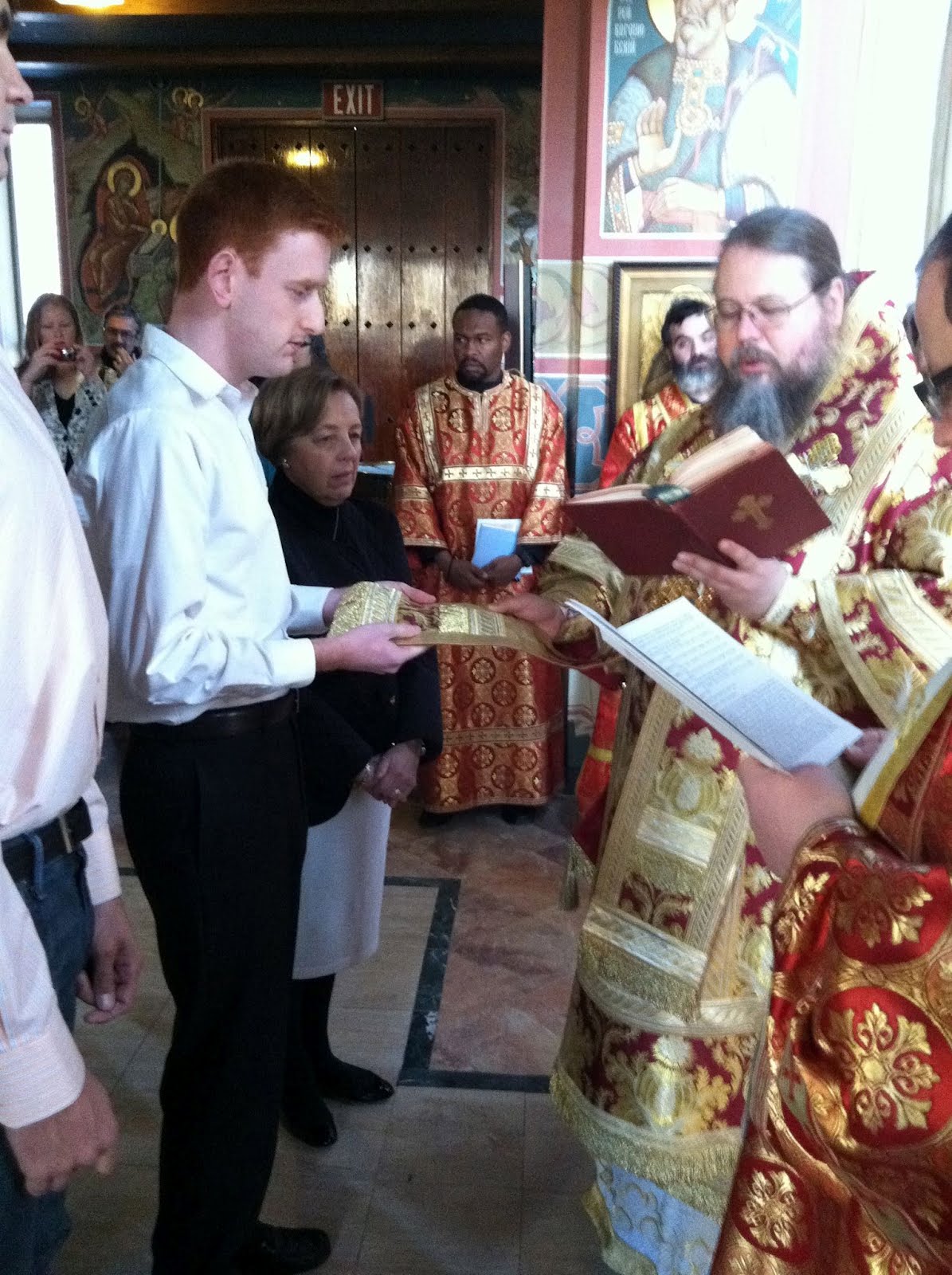
Like Baptism, the sacrament of Chrismation is granted only once in the lifetime of each Orthodox Christian [Unless one has to be received back into the Church after a lapse in Faith, Fall into schism or heresy or in Penance]. When we are chrismated the seeds of perfection are implanted in our souls, giving us the potential to grow "to the stature of men in Christ." The doorway to all the "fruits of the Spirit" mentioned in Scripture is opened to us. Whether we go through that doorway into the inheritance prepared for us in Christ depends only on our willingness to labor over ourselves, to bring alive, through prayer and repentance and spiritual struggle, the promise given us by God at Baptism. --Orthodox America
http://www.roca.org/OA/56/56H.htm
We Magnify THEE - Serbian Chant (Valaam St. Petersburg Metochion Choir, Slavonic)
+++
The St. Petersburg Valaam Metochion Choir sings "We Magnify Thee, O Lifegiver Christ..." (Serbian Chant) at St. John the Baptist Russian Orthodox Cathedral (ROCOR) in Washington, DC, 2002
+++
Translation:
"We magnify Thee, O Christ the Giver of life, Who for our sake now art baptized in the flesh by John, in the waters of the Jordan."
St. Dionysius of Alexandria: Persevere in Admonishing Even Those Who Choose Evil
 From The Holy Gospel According To St. John 13: 10, 11 (NIV):
JESUS answered, "A person who has had a bath needs only to wash his feet; his whole body is clean. And you are clean, though not every one of you." For HE knew who was going to betray him, and that was why he said not every one was clean.
How great is the example YOU showed of enduring evil! How great, too, is YOUR model of humility! How is it that the LORD gave us this example to show us that we shouldn't give up counseling our neighbors even if they aren't affected by our words? For incurable wounds are wounds that can't be healed by harsh medications or by more pleasant ones. Similarly, the soul, when it has been taken captive, gives itself up to wickedness, refuses to consider what is profitable for it, and won't accept goodness despite great counsel. As if it is deaf, it won't benefit from any advice. Not that it can't, but it won't. This happened in Judas' case. Nevertheless, CHRIST, although HE knew this beforehand, didn't ever stop doing everything to counsel him. Since we know that JESUS practiced this, we also should never stop striving to set the careless right even if it seems no good comes from our counsel. --St. Dionysius of Alexandria
Elder Paisios the Athonite: GOD Has A Way of Providing

GOD has a way of providing. He sees our needs, our desires; and, when something is for our good, HE gives it to us. When someone needs help in something, CHRIST and the Panaghia help. The Elder Philaretos was often asked, "Geronda, what would you like for us to provide for you?" And he would answer, "Whatever I want, Panaghia will send it." And that is what would happen. --Elder Paisios the Athonite
St. Justin (Popovich) of Chelje
Time and Signs of the Second Coming of Christ - St. Justin Popovich:
+++
St. Justin Popovich of Cheliye
Time and Signs of the Second Coming of Christ
Music: Sergei Rachmaninov
Vespers - Hexapsalmos; Hail, Gladdening Light
USSR Ministry of Culture Chamber Choir, conductor Valery Polyansky
+++
Archimandrite Justin (Popovic) ,pt 1/3 - "He always preached...":
+++
"He always preached,regardless of number of people in church..."
"He spoke harshly,he said what he meant,he didn't mince his words..."
"He was preaching so fervently,that it seemed to me once he did not touch the ground.It was St.Elias.As if he saw St.Elias Himself."
As an ecclesiastical person and clergyman Father Justin spent 31 years in the Ćelije Monastery under the continuous surveillance of the Communist Party police. Considered ineligible by the Communist party, together with a few fellow professors, he was ousted from the Faculty in 1945. The Communists limited his public appearances within monastic confines.
A devoted monk and philosopher of the Eastern Orthodox theology, elder Justin Popović was a great critic of ecumenism, providing it was inclined towards relativization of the God's Truth. (Fr. John Meyendorff, professor of the Academy of St. Vladimir now in Crestwood, New York (associated with Columbia University) - and every bit as much a critic of the "Catholic novelties" and the Pope's anti-Christianity. Until the end of his life Father Justin was a dedicated creator, and it is no wonder that his work is considered as a great contribution to the Orthodox theology and he himself as the secret conscience of the Serbian Church and the entire martyr's Orthodox religion (according to John N. Karmiris, the Greek academician).
http://en.wikipedia.org/wiki/Justin_Popovi%C4%87
He was cannonized as a saint 29.4.2010
+++
Archimandrite Justin (Popovich),pt 2/3 - "A holy man who helped sick people....":
+++
Archimandrite Justin (Popovich) (1894-1979) ,a famous monk from Serbia,has been well known through whole Orthodox world.
"He was simple and calm man radiating holiness while talking to someone"
"Father Justin was a saint in his lifetime"
"A holy man who helped sick people.He healed many of them,those who were helpless cases for medicine..."
"There were many miracles... He was a miracle itself"
+++
Archimandrite Justin Popovich,pt 3/3 "If you visit Serbia...":
+++
Archimandrite Justin (Popovich) (1894-1979), a famous monk from Serbia,has been well known through whole Orthodox world.
"The late Fr.Makarije Popovich,the prior of Decani said "If you visit Serbia and don't visit Fr.Justin, it would be as if you went to Rome and didn't see the Pope"
+++
+++
St. Justin Popovich of Cheliye
Time and Signs of the Second Coming of Christ
Music: Sergei Rachmaninov
Vespers - Hexapsalmos; Hail, Gladdening Light
USSR Ministry of Culture Chamber Choir, conductor Valery Polyansky
+++
Archimandrite Justin (Popovic) ,pt 1/3 - "He always preached...":
+++
"He always preached,regardless of number of people in church..."
"He spoke harshly,he said what he meant,he didn't mince his words..."
"He was preaching so fervently,that it seemed to me once he did not touch the ground.It was St.Elias.As if he saw St.Elias Himself."
As an ecclesiastical person and clergyman Father Justin spent 31 years in the Ćelije Monastery under the continuous surveillance of the Communist Party police. Considered ineligible by the Communist party, together with a few fellow professors, he was ousted from the Faculty in 1945. The Communists limited his public appearances within monastic confines.
A devoted monk and philosopher of the Eastern Orthodox theology, elder Justin Popović was a great critic of ecumenism, providing it was inclined towards relativization of the God's Truth. (Fr. John Meyendorff, professor of the Academy of St. Vladimir now in Crestwood, New York (associated with Columbia University) - and every bit as much a critic of the "Catholic novelties" and the Pope's anti-Christianity. Until the end of his life Father Justin was a dedicated creator, and it is no wonder that his work is considered as a great contribution to the Orthodox theology and he himself as the secret conscience of the Serbian Church and the entire martyr's Orthodox religion (according to John N. Karmiris, the Greek academician).
http://en.wikipedia.org/wiki/Justin_Popovi%C4%87
He was cannonized as a saint 29.4.2010
+++
Archimandrite Justin (Popovich),pt 2/3 - "A holy man who helped sick people....":
+++
Archimandrite Justin (Popovich) (1894-1979) ,a famous monk from Serbia,has been well known through whole Orthodox world.
"He was simple and calm man radiating holiness while talking to someone"
"Father Justin was a saint in his lifetime"
"A holy man who helped sick people.He healed many of them,those who were helpless cases for medicine..."
"There were many miracles... He was a miracle itself"
+++
Archimandrite Justin Popovich,pt 3/3 "If you visit Serbia...":
+++
Archimandrite Justin (Popovich) (1894-1979), a famous monk from Serbia,has been well known through whole Orthodox world.
"The late Fr.Makarije Popovich,the prior of Decani said "If you visit Serbia and don't visit Fr.Justin, it would be as if you went to Rome and didn't see the Pope"
+++
Wednesday, June 13, 2012
St. Isaac the Syrian: The Gift of Repentance
 Repentance has been given to mankind as a grace beyond grace. Repentance is a second birth from GOD. This second birth we receive in earnest in Baptism.
Repentance is the gateway to mercy which is open for all who seek it. By way of this gate we enter divine mercy, and apart from this entrance one cannot find mercy.
For "all have sinned", according to divine Scripture, "and are jusified freely by grace" (Rm. 3:23,24). Repentance is the second grace and is born in the heart as a result of faith and fear.
Fear is the paternal rod which guides us as far as the spiritual Eden; but once we have reached there, it leaves us and turns back.
Eden consists in divine love, wherein is the paradise of all blessedness. This is where St. Paul received supernatural sustenance.
After having tasted of the tree of life, he explained, saying, "Eye has not seen, nor ear heard, nor has it entered the human heart, what GOD has prepared for those who love HIM" (I Co. 2:9). --St, Isaac the Syrian
Cherubimic Hymn - Georgian Chant
+++
Georgian Lyrics:
Romelni Qeurubimta saidumlod vemsgavsenit da ckhovelmskopelsa samebasa samtsmida arsobisa galobasa shevstsiravt, kovelive msoplio dauteot zrunva.
Tuesday, June 12, 2012
St. Cyprian of Carthage: Take Heart in the End Times
 From the Holy Gospel According to St. Matthew 24: 7, 8 (NLT):
The nations and kingdoms will proclaim war against each other, and there will be famines and earthquakes in many parts of the world. But all this will be only the beginning of the horrors to come.
Those who fight for GOD, having been placed in the heavenly army, should hope for the things prophesied. Since the LORD told us these things would come, we won't tremble at the storms and whirlwinds of the world and will have no cause for alarm. The encouragement of HIS foreseeing WORD instructs, teaches, prepares, and strengthens the people of HIS Church to endure the things to come. HE predicted that wars, famines, earthquakes, and plagues would arise everywhere. For fear that an unexpected and new evil should shake us, HE previously warned us that suffering would increase more and more in the last times. The Kingdom of GOD, beloved, is almost at hand. The reward of life, the rejoicing of eternal salvation, and the eternal joy and obtaining of Paradise are coming now with the passing away of the world. Already, heavenly things are taking the place of earthly, great things and small, and eternal things of things that fade away. What room is there here for anxiety and concern? Who, in the midst of these things, is trembling and sad except those without hope and faith? For it is those who aren't willing to go to CHRIST who fear death. It is those who don't believe that they are about to reign with CHRIST who aren't willing to go to CHRIST. --St. Cyprian of Carthage
The Shepherd of Hermas: The Twelth Mandate

(I)
...Rid yourself of all evil desire, and clothe yourself with the desire that is good and holy, for when you have clothed yourself with this desire, you will hate the evil desire and control it as you wish. For the evil desire is savage and only tamed with difficulty, for it is terrible and utterly destroys men by its savageness; in particular, if a servant of GOD gets entangled in it and lacks understanding, he will be terribly destroyed by it. It destroys such as do not have the garment of the good desire but are mixed up with this world. These it hands over to death. ...Hear...the kind of works by which the evil desire puts to death GOD's servants. ...
+++
(II)
...Above all is the desire for someone else's wife or husband, and for the extravagances of wealth, and for many needless things to eat and drink, and many other foolish luxuries. For every luxury is foolish and futile for GOD's servants. These desires, then, are evil and bring death to GOD's servants. For these evil desires are the daughters of the devil. You must keep away, therefore, from evil desires, in order that by keeping away from them you may live to GOD. But those who are mastered by them and do not resist them will utterly perish, for these desires are deadly. But put on the desire of righteousness and, having armed yourself with the fear of the LORD, resist them. For the fear of the LORD lives in the good desire. If the evil desire sees you armed with the fear of GOD and resisting it, it will flee far from you and will no longer be seen by you, because if fears your weapons. So you, when you have triumphed over it, come to the desire of righteousness and deliver to it the victory you have won, and serve it just as it desires. If you serve the good desire and submit to it, you will be able to master the evil desire and control it as you wish. ...
+++
(III)
...Practice righteousness and virtue, truth and the fear of the LORD, faith and gentleness, and whatever good things are like these. By practicing these you will be an acceptable servant of GOD and will live to HIM; indeed, all who serve the good desire will live to GOD.
...You have the commandments [mandates]; walk in them and encourage your listeners, in order that their repentance may be pure the rest of the days of their lives. Carefully execute this ministry which I am giving you and you will accomplish much. For you will find favor with those who are going to repent, and they will obey your words, for I will be with you...
...If you propose to yourself that they can be kept, you will keep them easily and they will not be hard. But if the idea that they cannot be kept by man has already entered your heart, you will not keep them. But now I say to you: if you do not keep them, but neglect them, you will not have salvation, nor will your children nor your family, since you have already decided for yourself that these commandments cannot be kept by man. ...

+++
(IV)
...Foolish man, lacking understanding and double-minded, don't you understand how great and mighty and marvelous GOD's Glory is, because HE created the world for the sake of man, and subjected all HIS creation to man, and gave him all authority to rule over everything under heaven? If then...man is lord of all GOD's creatures and rules over everything, can't he also master these commandments? The man who has the LORD in his heart...can master everything, including all these commandments. But to those who have the LORD on their lips but whose heart is hardened and who are far from the LORD these commandments are hard and difficult. You, therefore, who are empty and fickle in the faith, put the LORD in your heart, and you will realize that nothing is easier or sweeter or more gentle than these commandments.
You who walk in the commandments of the devil, which are difficult and bitter and savage and licentious, be converted and do not fear the devil, for he has no power against you. For I, the Messenger of Repentance, WHO has mastery over him, will be with you. The devil can only cause fear, but his fear has no force. Do not fear him, and he will flee from you. ...
+++
(V)
...He cannot...oppress GOD's servants who hope in HIM with all their heart. The devil can wrestle with them, but he cannot throw and pin them. So, if you resist him, he will be defeated and flee from you in disgrace.
But those...who are empty fear the devil, as if he has power. When a man fills a large number of jars with good wine, and among those jars a few are partially empty, he does not bother to examine the full jars when he comes to the jars, for he knows that they are full. But he does examine the partially empty ones because he fears they may have turned sour. For partially empty jars quickly turn sour, and the taste of the wine is ruined. So also the devil comes to all GOD's servants to empty them. All those who are full in the Faith resist him mightily, and he leaves them alone, because he finds no place where he can gain entrance. So then he comes to those who are partially empty, and finding a place he enters them, and then he does what he wants with them, and they become enslaved to him. ...

+++
(VI)
...But I, the Messenger of Repentance, say to you: do not fear the devil. For I was sent...to be with you who repent with all your heart, and to strength you in the Faith. So believe in GOD, you who because of your sins have despaired of your life, and are adding to your sins are making your life hard, because if you turn to the LORD with all your heart, and practice righteousness the rest of the days of your life, and serve HIM rightly according to HIS Will, HE will heal your previous sins, and you will have power to conquer the devil's works. But do not fear the devil's threats at all, for he is as powerless as a dead man's sinews.
Listen to me, therefore, and fear HIM WHO is able to do everything, to save and destroy, and keep these commandments, and you will live to GOD. ...
...You will keep them...if your heart is pure to the LORD; indeed, all who cleanse their hearts of vain desires of this world will keep them, and will live to GOD... --The Shepherd of Hermas - Mandate 12 (mid second century AD)
Father A James Bernstein: WHO GAVE US THE NEW TESTAMENT?

"The history of early Christianity clearly reveals that God used His Church, composed of flesh-and-blood Christians, as active participants in the process of selecting and establishing the New Testament canon, just as He used real people —with feelings, emotions, unique backgrounds and perspectives—to write the twenty-seven separate books."
+++
Sometimes it is easy to overlook the obvious. Take, for instance, the New Testament. Even though every Christian really knows better, it is easy to forget that the New Testament was not written as one continuous book. Rather, it is a collection of twenty-seven shorter writings which were penned by a variety of authors at differing times and geographical locations and compiled much later. Nowhere in the New Testament do we find a list of what books belong in the New Testament. The “canon” of Scripture is, of course, not “scriptural.”
This brings up anther important question which may not be so obvious. Who, then, decided which books should be included in the New Testament canon and which ones left out?
As a Jewish convert to Christianity via evangelical Protestantism, I once refused to acknowledge that the Church had anything to do with compiling the New Testament. I wanted to believe God chose and collected these books without human involvement. The books, I assumed, somehow validated themselves beyond all reasonable doubt, and early Christians merely recognized their obvious scriptural status.
Though there is some degree of truth in this position, it is by itself naive and unbalanced. The history of early Christianity clearly reveals that God used His Church, composed of flesh-and-blood Christians, as active participants in the process of selecting and establishing the New Testament canon, just as He used real people—with feelings, emotions, unique backgrounds and perspectives—to write the twenty-seven separate books.
+++

What Bible Did the Apostles Use?
“All Scripture is given by inspiration of God” (II Timothy 3:16). I had always assumed that the “Scripture” spoken of in this passage included both the Old and New Testament. In reality, there was no official “New” Testament when this statement was made. Even the Old Testament was still in the process of formulation, for the Jews did not decide upon a definitive list or canon of Old Testament books until after the rise of Christianity.
As I studied further I discovered that early Christians used a Greek translation of the Old Testament called the Septuagint. * This translation, which was begun in Alexandria, Egypt, in the third century B.C., contained an expanded canon which included a number of the so-called “deutero-canonical” books. Although there was some initial debate over these books, they were eventually received by Christians into the Old Testament canon.
In reaction to the rise of Christianity the Jews narrowed their canons and eventually excluded the deutero-canonical books—although they still regarded them as sacred. The modern Jewish canon was not rigidly fixed until the third century A.D. Interestingly, it is this later version of the Jewish canon of the Old Testament, rather than the canon of early Christianity, which is followed by most of the Protestant Church today.
+++

History in the Making
The history of the New Testament canon and its development is a fascinating subject — and crucial to the understanding of both the Bible and the Church. For over two hundred years a number of books we now take for granted as being part of the New Testament were disputed by the Church before being included. Many other books were considered for inclusion, but eventually excluded. I was shocked when I first discovered that the earliest complete listing of all twenty-seven books of the New Testament was not given until A.D. 367, by Athanasius, a bishop in Egypt.
This means that the first complete listing of New Testament books as we have them today didn’t appear until over 300 years after the death and Resurrection of Christ. Imagine it! If the New Testament were begun at the same time as the U.S. Constitution, we wouldn’t see a final product until the year 2087!
During the first four centuries there was substantial disagreement over which books should be included in the canon of Scripture. The first person we know of who tried to establish a New Testament canon was the second-century heretic, Marcion. He wanted the Church to reject its Jewish heritage, and in so doing dispense with the Old Testament entirely. Marcion’s canon included only one Gospel, which he himself edited, and ten of Paul’s epistles. That’s it!
Many believe that it was partly in reaction to this distorted canon of Marcion that the early Church determined to have a clearly defined canon of its own. The destruction of Jerusalem in A.D. 70, the breakup of the Jewish-Christian community of Jerusalem, and the threatened loss of continuity in the oral tradition probably also contributed to the sense of urgency to standardize the list of books Christians could rely on.
+++

The Gospel according to Whom?
The four Gospels were written from thirty to seventy years after Jesus’ death and Resurrection. In the interim, the Church relied on oral tradition—the accounts of eye-witnesses—as well as scattered documents and written tradition. I was very surprised to discover as I first studied the early Church that many “Gospels” besides those of the New Testament canon were circulating in the first and second centuries.
These include the Gospel according to the Hebrews, the Gospel according to the Egyptians, and the Gospel according to Peter, just to name a few.
The New Testament itself speaks of the existence of such accounts. Saint Luke’s Gospel begins by saying, “Inasmuch as many have taken in hand to set in order a narrative of those things which are most surely believed among us ... it seemed good to me also, having had perfect understanding of all things from the very first, to write to you an orderly account ...“ In time, all but four Gospels were excluded from the New Testament canon.
In the early years of Christianity there was even a controversy over which of the four Gospels to use. The Christians of Asia Minor used the Gospel of John rather than the Gospels of Matthew, Mark, and Luke. Based upon the Passion account contained in John, Christians in Asia Minor celebrated Easter on a different day than those in Rome, which resisted the Gospel of John and instead used the other Gospels. The Western Church for a time hesitated to use the Gospel of John because the Gnostic heretics also made use of it in addition to their own “secret Gospels.”
Another controversy arose over the issue of whether there should be separate Gospels or one single composite Gospel account. In the second century, Tatian, who was Justin Martyr’s student, published a single composite “harmonized” Gospel called the Diatessaron. The Syrian Church used this composite Gospel in the second, third, and fourth centuries. This is the very Church to which “the Nazares” (Jewish Christians of Jerusalem) eventually migrated after the fall of Jerusalem to the Romans in A.D. 70. The Syrian Church did not accept all four Gospels until the fifth century. They also ignored for a time the three epistles of John, and Second Peter.
+++

Other Controversial Books
My favorite New Testament book, the Epistle to the Hebrews, was clearly excluded in the Western Church in a number of listings of the second, third, and fourth centuries. Prominent among reasons for excluding this book were concerns over its authorship. Primarily due to Augustine and his influence upon certain North African councils, the Epistle to the Hebrews was finally accepted in the West by the end of the fourth century.
On the other hand, the book of Revelation, also known as the Apocalypse, written by the Apostle John, was not accepted in the Eastern Church for several centuries. Once again, questions concerning authorship of the book were at the source of the controversy. Among Eastern authorities who rejected this book were Dionysius of Alexandria (third century), Eusebius (third century), Cyril of Jerusalem (fourth century), the Council of Laodicea (fourth century), John Chrysostom (fourth century), Theodore of Mopsuesta (fourth century), and Theodoret (fifth century). In addition, the original Syriac and Armenian versions of the New Testament omitted this book. Many Greek New Testament manuscripts written before the ninth century do not contain the Apocalypse, and it is not used in the liturgical cycle of the Eastern Church to this day.
Athanasius supported the inclusion of the Apocalypse, and it is due primarily to his influence that it was eventually received into the New Testament canon in the East. The early Church actually seems to have made an internal compromise on the Apocalypse and Hebrews. The East would have excluded the Apocalypse from the canon, while the West would have done without Hebrews. Simply put, each side agreed to accept the disputed books of the other.
+++
Who Decided?
With the passage of time the Church discerned which writings were truly Apostolic and which were not. It was a prolonged struggle taking place over several centuries in which the Church decided what books were her own. As part of the process of discerning, the Church met together in council. These various Church councils met to deal with many varied issues, among which was the canon of Scripture.
These councils met to discern and formally confirm what was already generally accepted within the Church at large. They did not legislate Scripture as much as they set forth what had become self-evident truth and practice within the Churches of God. The councils sought to proclaim the common mind of the Church and reflect the unanimity of faith, practice, and tradition of the local Churches represented.
The Church Councils provide us with specific records in which the Church spoke clearly and in unison as to what constitutes Scripture. Among the many councils that met during the first four centuries, two particularly stand out:
1.The Council of Laodicea, which met in Asia Minor, around A.D. 363. This council stated that only canonical books of the Old and New Testaments should be used in the Church. It forbade reading other books in Church. It enumerated the canonical books of our present Old and New Testaments, with the exception of the Apocalypse of Saint John. This is the first council which clearly listed the canonical books. Its decisions were widely accepted in the Eastern Church.
2.The Third Council of Carthage, which met in North Africa, around A.D. 397.This Council, attended by Augustine, provided a full list of the canonical books of both Old and New Testaments. The 27 books of the present day New Testament were accepted as canonical. It also held that these books should be read in the Church as Divine Scripture to the exclusion of all others. This Council was widely accepted as authoritative in the West.
+++

A Question of Authority
As I said at the beginning of this article, the history of the New Testament canon and its development is crucial to a proper understanding of both the Bible and the Church. The implications are indeed profound, and they call for some serious heart-searching on the part of all Christians. I would like to conclude on a personal note by showing you exactly how profound these implications can be. For they brought about some radical changes in my life—not only in how I came to approach Scripture and its interpretation, but in how I now relate to Christ’s holy Church in its historical expression.
Soon after my own conversion to Christianity I found myself getting swept up in the tide of Christian sectarianism which is so pervasive in the Protestant world. In fact, I eventually became so sectarian that I came to believe that all Churches were non-biblical. To become a member of any Church was to compromise the Faith. A close friend of mine even wrote a book called The Bible Versus the Churches, in which he argued that the Bible was true, and in conflict with Churches, all of which were false.
For me, Church became “the Bible, God, and me.” My attitude towards others was, “Tell me what you believe and I’ll tell you where you’re wrong!” Even my Christian friends became suspect. And my friend who wrote The Bible Versus the Churches came to believe that the Bible was in conflict with me as well! We parted ways.
This hostility towards Churches fit in well with my being a Jew. I naturally distrusted Churches because I felt they had betrayed the teachings of Christ in having persecuted or passively ignored the persecution of the Jews throughout history. As I became increasingly sectarian, indeed even obnoxious and anti-social, I slowly began to realize that something was seriously wrong with my approach to Christianity. I also realized that many of my Jewish-Christian brethren had also fallen into an elitist and sectarian “super-Christian” mold, believing that they were on a mission to clean up “Gentile Christianity.”
This realization led me to a sincere study of the history of the early Church, where I discovered four centuries of discussion and debate over which books should be included and excluded from the New Testament canon. It soon became clear to me that I was dealing with a larger issue— the issue of Church authority.
Biblical scholarship had given me four criteria to determine if a book was to be included as canonical:
1.It must be written by Apostles or disciples of the Apostles.
2.It must be considered inspired of God.
3.It must be accepted by the Church.
4.It must conform to the oral tradition and rule of faith taught by the Church.
I had no difficulty accepting the first two criteria. I wrestled mightily, however, with the thought that the Church had been given the authority to judge what books composed Scripture. Ultimately, it came down to a single issue. I already believed that God spoke authoritatively through His written Word. Could I now accept the fact that He spoke authoritatively through His Church as well—the very Church which had protected, preserved, and actively produced the Scriptures I held so dear?
+++

The Church of the New Testament
For the earliest Christians, God spoke His Word not only to but through His Body, the Church, and it was within His Body, the Church, that the Word was confirmed and established. Without question the Scriptures were looked upon by early Christians as God’s active revelation of Himself to the world. At the same time, the Church was looked upon as the household of God, “having been built on the foundation of the Apostles and prophets, Jesus Christ Himself being the chief cornerstone, in whom the whole building, being joined together, grows into a holy temple in the Lord” (Ephesians 2:20-21).
There was no organic separation between Bible and Church as we find so often today. The Body without the Word is without message, but the Word without the Body is without foundation. As Paul says in I Timothy 3:15, “The church of the living God, the pillar and ground of the truth.” The Church is the living body of the incarnate Lord. She is an integral part of the Gospel message and it is within the context of the Church that the New Testament was conceived and preserved.
This study was instrumental in my eventual conversion to the Orthodox Faith. If the Church was not just a tangent or a sidelight to the Scripture, but rather an active participant in its development and preservation, then it was time to reconcile my differences and abandon my prejudices. Rather than try to judge the Church by my modern understanding of what the Bible was saying, I needed to come into union with the Church that produced the New Testament, and let her guide me into a proper understanding.
To make a long story short, I am now an Orthodox priest serving in Seattle, Washington, and am striving to witness to the power of God’s Holy Church. To those who, like I once did, stand dogmatically on “Sola Scriptura,” in the process rejecting the Church of God which not only produced the New Testament, but also selected through the guidance of the Holy Spirit those books which compose the New Testament, I would say only this:
Study the history of the early Church and the development of the New Testament canon. Use source documents where possible. (It is amazing how some of the most “conservative” Bible scholars of the evangelical community turn into cynical and rationalistic liberals when discussing Church history.) Examine for yourself what happened to God’s people after the 28th chapter of the book of Acts.
If you examine the data and look with objectivity at what occurred in those early days, I think you will discover what I discovered. The history of God’s Church didn’t stop with the first century. If it had, we would not possess the New Testament books which are so dear to every Christian believer. The phenomena of separating Church and Bible which we see so prevalent in much of today’s Christian world is a modern phenomena. Early Christians made no such artificial distinctions.
Once you have examined this data, I would encourage you to find out more about the historic Church which produced the New Testament, preserved it, and selected those books which would be part of its canon. Every Christian owes it to himself or herself to find out more about this Church and to understand its vital role in proclaiming God’s Word to our own generation.
Fr. A. James Bernstein is the pastor of Saint Paul Orthodox Church in Lynnwood, Washington.
+++

* The Psalter according to the Seventy
The Use of the Septuagint by the Early Church
What Old Testament text did early Christians use when they prayed the Psalms? Many are surprised to learn that the official text was not the Hebrew or Masoretic text which forms the basis of most modern English translations today. In order to understand why, it is necessary to know something of the background of the text of the Old Testament.
At the time of Christ, the Apostles, and the early Church, Hebrew had long since ceased to be the commonly spoken language, even among the Jews. Although Jesus understood Hebrew, He would have spoken Aramaic – the common language of Palestine – with His disciples. ; Jesus and His disciples were probably familiar, at least to a certain extent, with Greek, the common language of the Roman Empire.
Because Greek was the most widely spoken and read language of the empire at large, a translation of the Hebrew Old Testament into Greek had been accomplished, according to tradition, by seventy translators, in the city of Alexandria, during the third century before Christ. The name Septuagint means “according to the seventy.” The Septuagint, or LXX, was without question the most common text of the Scriptures at the time of Jesus and the Apostles. It was the Old Testament of the early Church.
The other text used at that period was the Hebrew text that had been preserved by the rabbis and scribes of Israel. Those who read today about scriptural manuscripts will have undoubtedly run across references made to the “masoretic” texts, which means the texts of the scribes (who were known as “masoretes”).
In the first century, after the destruction of the Temple of Jerusalem in A.D. 70, and the end of the Jewish priesthood, the authority of the rabbis in Israel became absolute. Before that time the rabbis occupied a position secondary to the priests. The rabbis and scribes distrusted anything that was not written in the traditional Hebrew language, and consequently they rejected the Septuagint text. But for the early Church the Septuagint was always used. When the New Testament quotes the Old, which it frequently does, and when it quotes the Psalms, which it very frequently does, it quotes the Septuagint text exclusively. That is one of the reasons why the Orthodox Church today still continues to use the Septuagint text.
From what Hebrew text was the Septuagint translated? The actual Hebrew manuscripts which formed the basis of this translation, centuries before Christ, have been lost. The Orthodox Church believes that the Hebrew text upon which the Septuagint is based is actually older and more venerable than the Hebrew text of the scribes.
Though both texts, the Masoretic text and the Septuagint, are quite similar in many ways, there are significant differences. These differences can primarily be summed up by saying that the messianic prophecies found throughout the Psalms and the prophetic writings are far more explicit in the Septuagint text than in the Masoretic text.
 A careful study of the Psalms reveals how crucially different the Septuagint text is in these messianic portions. Orthodoxy regards the intensification of messianic prophecy that occurred in the Septuagint text to be the inspiration of the Holy Spirit preparing Israel for the coming of the Savior. As the time of the Messiah drew nearer and nearer, the prophecies of His coming became more and more explicit.
For the most part, translators during and after the Reformation, in an attempt to get back to what they thought were the roots of the Old Testament text, chose to use the Hebrew texts of the scribes and rejected the traditional use of the Septuagint. Therefore the Bibles most commonly available in English, whether they be NKJV or RSV or another English translation, are translations of the Hebrew text of the scribes, not translations of the Septuagint. The traditional text of the Orthodox Church, however, whether it be in her singing of the Psalms in worship, or her study of the Old Testament, is still the text of the early Church: the Septuagint.
Father A James Bernstein
From Again Magazine
Publication of the Antiochian Orthodox Christian Archdiocese of North America
Volume 15, No. 3, September 1992
pp. 7-10
Subscribe to:
Posts (Atom)